
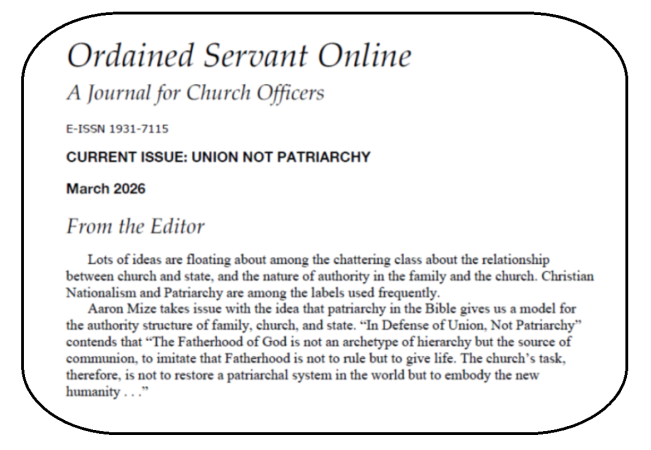
OPC denominational publications usually aren’t controversial. Yet the latest edition of Ordained Servant ran a feature article calling for gender equality against patriarchy. This radical view reflects neither the consensus of OPC teaching nor historical Reformed belief.
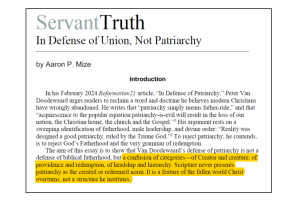
Pastor Aaron Mize insists that patriarchy, defined as “father-rule,” is a “feature of the fallen world Christ overturns.” Therefore, male headship over the family cannot be an inherent part of the created order.
Mize’s argument is based on deadly misunderstandings of the Genesis creation account. He constructs his case with a sleight-of-hand assessment that “the text of Genesis does not identify Adam’s chronological creation as an office of rule.” This is wrong for two reasons.
The first reason is that our Lord’s creation of things in time and space is not by happenstance. He could have created all things instantaneously. Yet He deigned to shape things in a certain order, such that man was created after the earth was formed and not before. Adam was made of the earth, not out of thin air.
This necessarily implies that the order of things is meaningful, depending upon the nature of the case and the circumstances. This is true with our Creator Himself. For example, God’s resting on the seventh day, and not the fourth, is consequential for all mankind until the resurrection of Christ.
In the same vein, we can see the significance of the formation of things and their order of creation in mankind’s birth. Adam and Eve were made after the formation and shaping of all things, showing that they are the crown of creation (Psalm 8 ). All things were created before Adam and Eve were formed because the things of creation will be used later by them in accordance to God’s command to have dominion.
This explanation arises from the Lord’s own words and actions for making us: “Let Us make man in Our image, according to Our likeness; let them have dominion… Then God blessed them, and God said to them, “Be fruitful and multiply; fill the earth and subdue it; have dominion over the fish of the sea, over the birds of the air, and over every living thing that moves on the earth.’”(1:26). These things were created first so that mankind would partake of them last.
Likewise, from the text itself, we can surmise that the formation of Adam, both as to substance and time, is significant for us. As Paul asked of the oxen, we can ask of the creation account: Was it for the sake of God that these things were created in the order and manner we read in Genesis? Or was it written for our instruction this day? For us today, that we would understand that the origin of men-in-Adam was different from that of women-in-Eve.
That Adam was formed of the earth and Eve was not is not a coincidence. The text reveals that men and women are already different. One’s genesis points to one’s purpose or telos. This fits the patriarchal teaching of the churches throughout the ages and contradicts modern assumptions of Adam and Eve being created as equal partners.
That she was created from Adam’s side to be a “helpmate” (or “helper comparable to him”) further indicates that her earthly telos is to be his aid. It is not the other way around, with Adam created from her side to aid her. Eve’s formation from man shows a biological closeness that repudiates androgyny and the sex sameness of egalitarian thinking.
Mize, however, oddly imports the quality of “partnership” into the word for “helper” (‘ezer), implying that her relationship with Adam must be equal in all respects: “[the word] is most often used of God himself as Israel’s helper…It conveys strength and partnership, not subordination.”
This non sequitur collapses on its own weight: God is our superior in any help He offers. This is not true for the woman, unless Mize thinks God is an equal partner in aiding us. Ultimately, this is a blasphemous thought.
The Genesis account also explains that God first gave instructions to Adam, the first man. He also named the animals. Neither of these things were true for Eve. Labeling was the first step in identification and dominion. In naming her “woman,” Adam set the tone of their relationship. Eve neither changed her name nor complained that the man had already exercised authority over her.
Thus, although both are described at the end of the first chapter as having dominion, this rule is differential. The man is the first and the first to name and rule, and the woman assists in that rule, having her origin dependent upon man’s rib. All these details establish patriarchy before the fall.
These theological implications against the forced reasoning of Mize’s article arise from considering the text in light of the nature of God. His attributes necessitate a careful reading of the text beyond a simplistic proof-texting used by the author.
Moreover, the second reason to link Adam’s creation with dominion dovetails with the Genesis text sublimely. Under divine inspiration, the Apostle in 1 Corinthians and 1 Timothy explains that the manner of and chronology of Adam and Eve are significant.
In 1 Corinthians 15, Paul’s long discourse contrasting the first and Second Adam only makes sense if the Genesis recording of the manner of man’s creation is significant. The Apostle states as much in verses 47-48: “As was the man of dust, so also are those who are made of dust; and as is the heavenly Man, so also are those who are heavenly. And as we have borne the image of the man of dust, we shall also bear the image of the heavenly Man.”
Mize’s claim is a straightforward challenge: “When God creates humankind male and female in his image, he communicates shared dominion and fellowship—not subordination of one to the other.”
But that unfounded declaration is contradicted by Paul’s use of Adam in chapter 15 and in Romans 5, where Adam and Christ are contrasted, not Eve and Christ. These two passages present Adam as superior to Eve, representing the human race as its head, in contrast to Christ, the head (ruler) of a new people (cp. 1 Cor. 11:3ff.).
In 1 Timothy, there is not much to comment upon for the meaning is clear enough that liberals and progressives constantly harp against it. Mize chose to ignore it instead: “And I do not permit a woman to teach or to have authority over a man, but to be in silence. For Adam was formed first, then Eve. And Adam was not deceived, but the woman, being deceived, fell into transgression.”
We cannot cast aside the Word of the Lord. The text of Genesis itself and Paul’s confirmation demonstrate the moral and theological importance of this matter, that male headship is intrinsic to mankind. This is a pressing matter the Orthodox Presbyterian Church must not yield.
(Part 3 of a series)