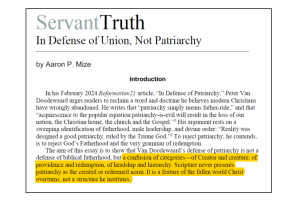
The March 2026 edition of the Orthodox Presbyterian Church’s magazine for officers, Ordained Servant, published an incongruous article that took the reader to the precipice of egalitarianism and feminism. The superficial argumentation and shocking assertions were markedly egalitarian, save for a vague caveat at the end of the essay.
Some leading church members and officers were concerned, wanting clarity and a rebuttal. Yet some claims are of such a ridiculous nature as not to be taken as serious discourse lest they be given public credence. Even so, to help prevent confusion in the church, some points must be made in the interest of biblical truth.
Pastor Aaron Mize, of Trinity Orthodox Presbyterian Church in Washington, contends that patriarchy, defined as “father-rule,” is a “feature of the fallen world Christ overturns.” It is a concession to the spirit of the age based upon a dubious assertion that Adam and Eve were created as equal partners. This necessarily implies that any authority structure after the fall is something akin to a concession to the sinful state of mankind (like the temporary existence of polygamy, it seems).
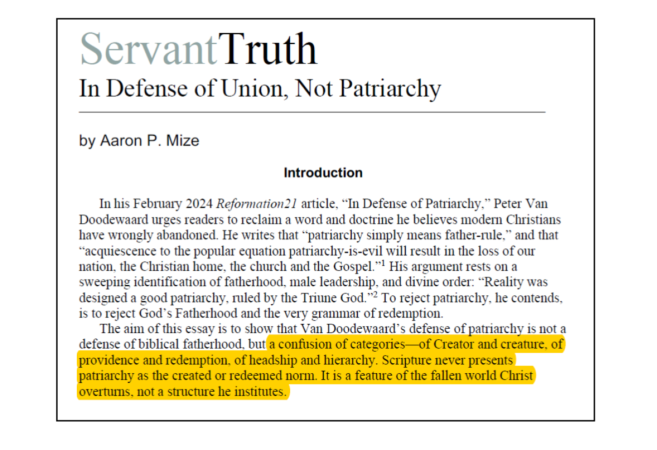
Furthermore, Mize treats any allusion to God’s persons of Father and Son as evidence of male-authority to be fallacious. He also attacks arguments for male leadership from the authority of Jesus Christ over the church. He says the Son’s headship is not the same as His rule as King, which is muted by union with Christ. The claims are, frankly, not well thought out.
A simple rejoinder is Paul’s own words which are strikingly missing from Mize’s article: “And I do not permit a woman to teach or to have authority over a man, but to be in silence. For Adam was formed first, then Eve. And Adam was not deceived, but the woman being deceived, fell into transgression” (1 Timothy 2:12-14).
This is Paul’s black-and-white affirmation that patriarchy existed before the fall. What the Creator formed and created at the beginning, even its order in time, is significant for us today. And the fall itself is proof of why women cannot lead nor teach in the church. It is a double-argument, binding Christians to a male-lead hierarchy.
Notice Paul’s equally transparent and interpretively-binding declaration in 1 Corinthians 11:3, 7-9: “But I want you to know that the head of every man is Christ, the head of woman is man, and the head of Christ is God… he [man] is the image and glory of God; but woman is the glory of man. For man is not from woman, but woman from man. Nor was man created for the woman, but woman for the man.” Paul clearly ties other practices (such as head-coverings) to nature and creation, assuming the traditional understanding of the Genesis account.
Mize’s other claim about Christ’s headship that “In Scripture, Christ’s headship is organic and mystical, not hierarchical or official” is easily answered. The word “head” (kephalē, Gk.) is widely understood to describe both an organic and hierarchical relationship.
Circling back to 1 Corinthians, chapter eleven demonstrates that Paul’s use of “head” necessitates authority and rule. In verse 10, Paul explicitly ties females’ covering as public evidence of “authority” or “power” or of rule and rank that Paul described at the beginning: God, Christ, man & woman. (v.3).
Mize did not handle these crucial texts. Moreover, his article’s quick deletion without comment suggests disagreement with the OPC’s doctrinal consensus. Importantly, the article undoubtedly portrays the OPC in a wrong light.
This controversy raises important questions for our churches about our understanding of the Bible, our history, and our subordinate standards. These issues deserve a thoughtful response.
(Part 2 of a series)